Sep 12, 2026Buying Guides
T300 vs T700 Carbon Fiber: How to Choose Your Custom Pickleball Paddle
Compare T300 and T700 carbon fiber paddles by weight, size, and thickness, then plan your custom OEM or ODM order.
Two spec sheets sit side by side on your desk, and both say pickleball paddle. One reads T300 carbon fiber, 219 g, 405 x 200 x 10.5 mm. The other reads T700 carbon fiber, 224 g, 415 x 190 x 16 mm. If you are sourcing custom paddles for a club program, a retail line, or a promotional campaign, those numbers decide whether the order fits your players or misses them. The gap between the two models is not marketing vocabulary. It is face material, thickness, and weight, and each one changes how a paddle plays. Ten minutes from here, you will know which line to put on your quote request.
Face Material Sets the Playing Style
Start with the face, because it is the layer your players feel on every strike. Both carbon paddles in the catalog share one core material, polypropylene, and both accept custom colors. The faces differ. The T300 model weighs 219 g and measures 405 x 200 x 10.5 mm. The T700 model weighs 224 g and measures 415 x 190 x 16 mm. The T300 paddle runs 5 g lighter, and its hitting area is 10 mm wider at 200 mm across, while the T700 paddle stretches 10 mm longer at 415 mm. A wider face can forgive off-center contact, and a longer face can add reach, so let your players' habits decide. Thickness is the next number to compare.
Thickness and Weight: Where the Trade-Offs Sit
The face is only half of the spec sheet, and thickness is where these two models truly part ways. The T300 paddle sits on a 10.5 mm platform, while the T700 paddle runs 16 mm, a 5.5 mm difference through the core. Buyers tend to notice thickness in two places: how the paddle carries its weight through a swing, and how the face responds at contact. Neither number is right for every roster, which is why the catalog keeps both in the lineup. Your sampling round will confirm the feel, but the dimensions here tell you which two samples to order.
Weight works the same way across a range. The catalog's kids paddle weighs 177 g, 355 x 177 x 10.5 mm, fiberglass-faced over the same polypropylene core family. From there, the fiberglass adult paddle comes in at 217 g on the 415 x 190 x 16 mm shell, the T300 at 219 g, and the T700 at 224 g. Spread from 177 g to 224 g, the range covers juniors through full-size adult play, and custom colors are available on every model, so a club or campaign can carry one visual identity across different paddle bodies and player groups. That settles the paddle side of the order.
Match the Paddles with the Right Balls
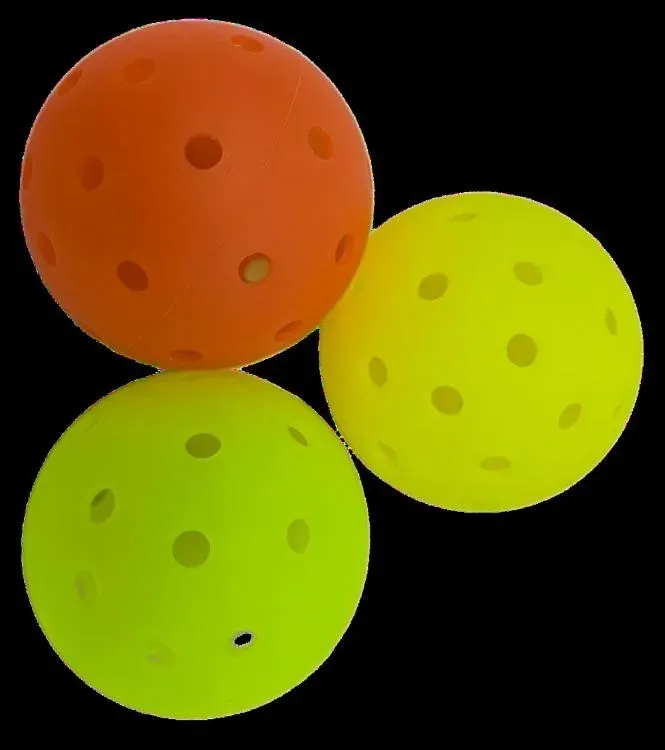
A paddle order rarely ships alone, and the ball line answers the same question of where your players compete. The standard 74 mm ball with 40 holes is the common choice for outdoor courts, while the 72 mm ball with 26 holes is typically used indoors. Hole count and diameter influence how a ball flies, so confirm which court your market plays on before you fix the ratio of balls to paddles. Get that wrong and the paddles arrive specced for a game your customers do not play.
The special editions extend the same 74 mm platform. The glow in the dark ball and the LED ball both come in 74 mm with 40 holes, built for evening and low-light sessions. Rotational molded balls appear in two variants, 74 mm with 40 holes and 74 mm with 48 holes, and a quiet 74 mm ball rounds out the line for venues where noise is a concern. Bundling these with your paddle order keeps a club program or promotional kit consistent from paddle face to ball.
From OEM or ODM Brief to Delivery
Specifications settled, the remaining decisions are branding and logistics, and the catalog handles both under OEM and ODM customization. Every paddle on the list carries custom colors, and your logo and artwork join the spec at this stage. The process runs in four steps. You share your idea: product needs, logo, and requirements. Design and sampling follow: mockups and samples are prepared for your approval. Approved samples move into mass production under quality control, and delivery covers on-time shipping to your destination. The sampling step deserves your attention, because it is where a T300 or T700 preference becomes a paddle you can actually swing.
Share your paddle requirements through the contact form when you are ready to move. State whether you lean toward the 219 g T300 at 405 x 200 x 10.5 mm or the 224 g T700 at 415 x 190 x 16 mm, add the player groups and weights you need, and include your logo and color plan. A request that precise comes back as a quote worth comparing, and the sample step turns it into a paddle your players can judge on court.